


Navratri 2026 Party Ideas: Garba, Food & Decor Guide

Navratri 2026 begins on Sunday, October 11 and runs for nine consecutive nights, closing the celebration with Dussehra on Tuesday, October 20. That is a very specific kind of deadline. Unlike a birthday party, where you choose the date and the vibe, Navratri hands you both: nine nights of dancing, an altar that shifts mood every evening, and a menu that has to work for guests who are fasting and guests who are not. If you're hosting for the first time — or hosting bigger than you have before — the difference between a lovely evening and a chaotic one usually comes down to three things: a dance floor that actually works, a food table that respects everyone's plate, and a decoration scheme that reads as festive rather than generic.
This guide walks through all of it: what the nine colours are for 2026, how to set up a garba floor in a living room or a community hall, what to serve when half your guest list is on a vrat diet, a planning timeline you can start four weeks out, and the hosting etiquette questions people are often too polite to ask. Everything is built so you can host one night or all nine.
What Is Navratri? A Quick Primer for Hosts
Navratri means "nine nights," from the Sanskrit nava (nine) and ratri (nights). The autumn observance — Sharad Navratri, also called Shardiya, Maha, or simply Navratri in much of North India — honours the goddess Durga across her nine forms, called the Navdurga. The nights recount her nine-day battle against the demon Mahishasura and end in his defeat on the tenth day, Vijayadashami or Dussehra.
What matters for hosting is that Navratri is not one event. It's a season, and it looks genuinely different depending on who is celebrating:
- Gujarat: garba and dandiya raas — circle dancing through the night, traditionally around a clay lamp or a decorated shrine.
- West Bengal: Durga Puja, with elaborate temporary pandals, public pavilions, and major observance days on Saptami, Ashtami, Navami and Vijaya Dashami.
- North India: home worship, jagratas (night-long devotional singing), and Kanya Pujan, where young girls are honoured as living forms of the goddess.
- South India: Dasara, most visibly in Mysuru, plus golu — tiered displays of dolls and figurines set up in homes — and Ayudha Puja, the blessing of tools and instruments.
That variety is your best design asset. You are not locked into one aesthetic. You can host a dance-first garba night, a quieter golu-and-prasad evening, or a mixed-generation gathering that borrows from all of it.
The Nine Colours of Navratri 2026: Your Ready-Made Palette
One of the easiest ways to make a Navratri gathering look intentional is to lean on the day's colour. Colour calendars are widely shared and give you a built-in theme for everything — dress code, table linen, balloons, even the cake frosting.
For Sharad Navratri 2026 the commonly published sequence runs like this:
- Day 1 — Sunday, October 11: Orange (Maa Shailputri) — grounding, resolve
- Day 2 — Monday, October 12: White (Maa Brahmacharini) — simplicity, discipline
- Day 3 — Tuesday, October 13: Red (Maa Chandraghanta) — courage, protection
- Day 4 — Wednesday, October 14: Royal Blue (Maa Kushmanda) — vitality, creative energy
- Day 5 — Thursday, October 15: Yellow (Maa Skandamata) — nurturing, learning, family
- Day 6 — Friday, October 16: Green (Maa Katyayani) — growth, determination
- Day 7 — Saturday, October 17: Grey (Maa Kalaratri) — fearlessness
- Day 8 — Sunday, October 18: Purple (Maa Mahagauri) — grace; Durga Ashtami and Kanya Pujan
- Day 9 — Monday, October 19: Peacock Green (Maa Siddhidatri) — Maha Navami
- Day 10 — Tuesday, October 20: Dussehra / Vijayadashami
Two honest caveats, and they matter if you're sharing this with guests. First, colour calendars are a social and clothing tradition rather than a compulsory part of worship, and different families, temples and regions follow different sequences — so treat the list as inspiration, not a rulebook. Second, calendar sources differ by a day on some observances: most list Durga Ashtami and Kanya Pujan on October 18 and Maha Navami on October 19, while some communities observe Ashtami and Navami together on the 19th. If you're planning a puja or a formal ritual, confirm timings with your local panchang or temple. For a party, the practical takeaway is simple: pick the colour of your party night, tell your guests, and let the table follow.
Decorating for Navratri: Rangoli, Diyas and a Living Altar
Navratri decor has a huge advantage over most party themes — the two most recognisable elements, rangoli and diyas, are cheap, endlessly repeatable, and look impressive even when executed by children.
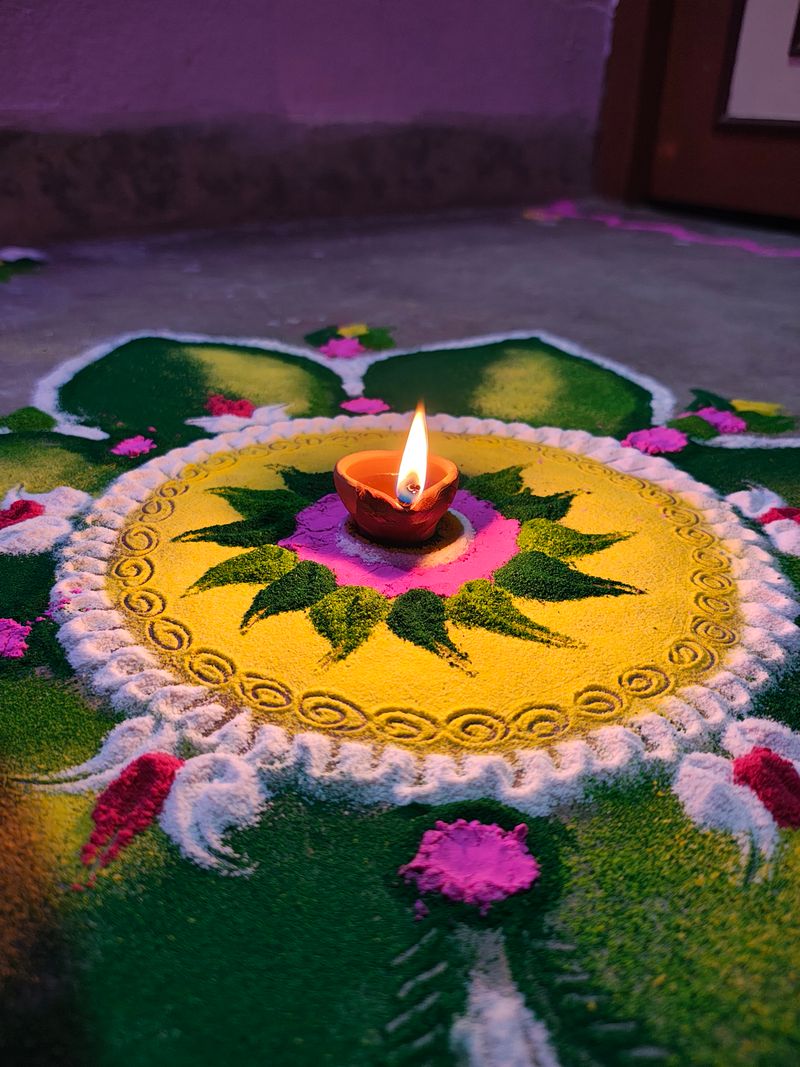
Start at the entrance. A rangoli at the doorway is the traditional welcome, and it sets expectations before anyone is inside. At a home party, a floor decal, coloured felt cut-outs, or a chalk-and-petal design on a porch all work; at a rented venue, check whether adhesives are allowed and use a fabric mat you can lift at the end of the night. Add a toran — a hanging garland of flowers or fabric — across the doorway.
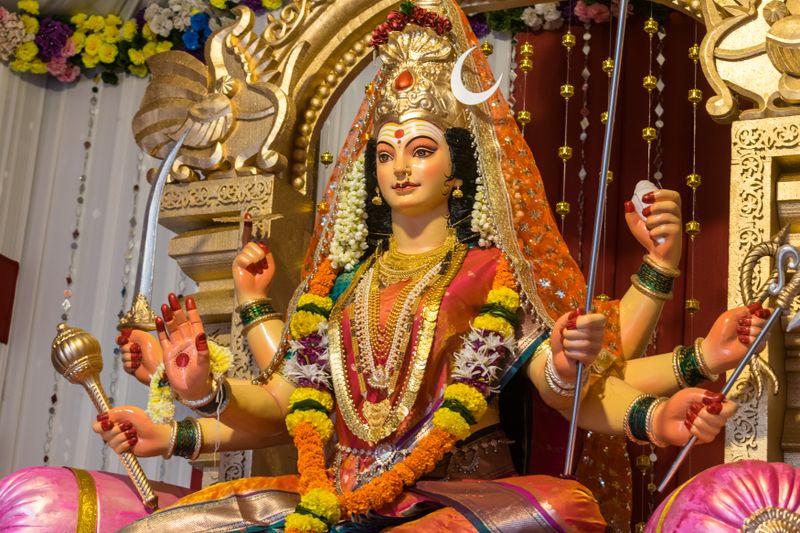
Build the altar as a focal point, not an afterthought. A small, elevated table with a clean cloth works. Add a kalash (a pot, often with mango leaves and a coconut on top) for Ghatasthapana traditions, a framed image or small murti, and a fresh flower offering each evening. If you want to extend the golu tradition, use a set of tiered shelves or stacked boxes to display figurines — this reads beautifully in photographs and doubles as a table centrepiece.
Light it with diyas, and then add safety. Clay oil lamps give the warm, flickering quality that fairy lights can't match. Use real diyas in stable, non-flammable trays well away from fabric, and add battery-operated LED diyas as a fallback for shelves, kids' tables, and anywhere near paper goods. If you're hosting a large crowd, blended lighting — real diyas at the altar, LED everywhere else — is the practical choice.
Drape fabric generously. Navratri colour schemes love cloth: sari-fabric runners, sheer drapes behind the altar, bright cushions on the floor for seating. This is also the cheapest way to make a plain room feel celebratory. Our festive paper plates collection is a good place to start matching table colours to your draping, and the party banners range covers letter banners if you want a "Happy Navratri" or "Garba Night" sign over the dance floor or food table.
Garba and Dandiya Night: How to Run a Dance Floor That Works
If your Navratri party has dancing — and most do — this is the section to read twice. Garba is circular, repetitive and community-building; done right, guests who have never danced it before join in within twenty minutes. Done badly, half the room stands at the edge holding a drink.
Give the circle room. A garba circle needs a clear diameter of roughly 12–15 feet for about 20 dancers, and it grows fast. Push furniture to the walls. If you're indoors, lift rugs or tape down the edges — the single most common Navratri party injury is a trip on a curling rug corner. Wood, laminate and finished concrete all dance well; deep carpet does not, and it will wear your guests out.
Stock dandiya sticks properly. Plan for one pair per guest plus a 20% buffer, because sticks get dropped, borrowed and taken home. Shorter sticks for children, longer pairs for adults, and a bin by the door for returns. Wooden sticks are the traditional choice and sound better; foam-capped sticks are safer for mixed-age groups and tight spaces.
Teach one move before you turn on the playlist. Open with a two-minute demo of a basic two-step and a dandiya tap. Have one experienced guest stand in the inner circle, not the outer, so newcomers behind them can copy. Start with slow, well-known tracks and build tempo over the first thirty minutes — starting at full speed empties the floor.
Play the set in three acts. Act one: gentle garba to warm up. Act two: dandiya raas, where the circle breaks into pairs and rotates. Act three: fast, high-energy tracks for guests who want to burn off the evening. Ninety minutes to two hours of dancing is the comfortable band for a home party, longer if you're in a hall. Build a playlist in advance and download it — you do not want to be troubleshooting a login while forty people wait for the beat.
Protect the floor around the floor. Put the drinks station at the opposite end of the room from the dance area, not beside it. A water station within arm's reach of the circle is essential; a water station in the middle of the circle is not.
The Food: Vrat-Friendly Menus That Don't Feel Like a Compromise
Navratri is the one party in the calendar where the menu needs a rule printed on it. Many guests observe a fast — vrat or upvas — during the nine days, which means no grains, no pulses or legumes, no onion or garlic, and often no ordinary salt. Others are not fasting at all. Your job as host is to make both groups feel catered to, and to make it obvious which dish is which.
Fasting-friendly staples that carry a whole buffet:
- Sabudana (tapioca pearls) — khichdi and vada are the workhorses, crisp, filling, and good at room temperature.
- Kuttu (buckwheat) and singhara (water chestnut) flour — for puris, parathas and pakoras.
- Samak rice (barnyard millet) — a rice substitute that behaves like rice in a pilaf.
- Makhana (fox nuts) — roast in ghee with rock salt for a snack bowl that disappears quickly.
- Potato and sweet potato — cubed, pan-roasted with cumin, or made into a simple chaat.
- Dairy — paneer tikka, raita, shrikhand, and a bowl of plain yoghurt with fruit.
- Fruit and nuts — a generous fruit platter and a nut-and-dried-fruit bowl for guests who want something light.
- Rock salt (sendha namak) and cumin — set these out separately so guests can season their own plate.
Then add a second, non-fasting track so guests who aren't observing vrat aren't limited to fruit: a rice dish, a dal, a paneer curry, flatbread, and something fried. Two clearly separated tables works better than one mixed table.
Label everything. This is the single highest-impact, lowest-cost thing you can do at a Navratri party. A folded card in front of each dish that says what it is and whether it's vrat-friendly ("Sabudana Khichdi — vrat") prevents fifteen conversations and four accidental mistakes. If you're serving a large group, add an ingredients note for the big allergens: dairy, peanuts, tree nuts, gluten.
Prasad is different from party food. If you're offering prasad, keep it on the altar or a separate table with its own plates, and distribute it after any puja rather than leaving it in the buffet line. Guests generally know to accept it with the right hand — a small sign helps those who don't.
Setting a Navratri Table That Handles Fasting, Feasting and a Crowd
Navratri food is eaten standing up, in two or three passes, often with a plate in one hand and a dandiya stick in the other. That shapes your tableware decisions more than any aesthetic consideration.
Go with sturdy disposables for a crowd. Nine nights of hosting is a lot of washing up, and a hall with no kitchen makes real plates impractical. Choose coated paper or bagasse plates that hold up to curries and ghee — thin, uncoated plates go translucent and buckle, which is exactly the wrong experience for a guest in a lehenga balancing a full plate.
Match tableware to the day's colour. If your theme is Thursday yellow or Tuesday red, a set of coloured plates, cups and napkins in that shade makes the table read as designed rather than improvised. Our party tableware range has colour families that work well with Navratri palettes, and a plain stack of coordinating napkins is the fastest way to pull a buffet together.
Use small formats deliberately. Navratri parties involve lots of little things — prasad portions, makhana, fruit, sweets, a scoop of shrikhand. Small cups and bowls are far better than full-size plates for these. Our snack cups are sized for exactly this and let guests graze while dancing without setting anything down.
Plan the drinks station as a circuit. One table, three zones: water, a chaas or lassi jug, and a mocktail station with fruit juice, soda, mint and lime. Keep it away from the dance circle and away from the altar.
Regional Variations: How the Same Nine Nights Look Different
If you want your party to feel considered rather than generic, borrowing deliberately from one regional tradition is much stronger than mixing everything. Here's what each brings.
Gujarati garba night. The most dance-forward format, and the easiest for mixed guest lists because the steps are teachable. Focus your spend on: a big clear floor, dandiya sticks, a well-built playlist, and light food that can be eaten in one hand. Decoration should stay low — floor-level diyas, a central lamp, draped fabric at the perimeter — so nothing blocks the circle.
Bengali Durga Puja evening. Rather than a dance floor, build a focal display — a decorated idol or framed image, an arch or pandal-style backdrop, and a table of offerings. The atmosphere is one of arrival and viewing. Spend on flowers, lighting, and a backdrop for photographs; food can be a sit-down or standing buffet with a wider non-fasting menu.
North Indian jagran and Kanya Pujan. A quieter, more devotional format where the gathering is centred on music and the honouring of young girls on Ashtami. The practical hosting needs here are seating, warmth for a long evening, and a proper prasad and Kanya Pujan spread — puri, chana, halwa — on small plates. If you're inviting children, keep their table at their height and use unbreakable tableware.
South Indian golu and Dasara. The golu display is the star: tiered shelves of dolls, figurines and miniature scenes, often added to each year. Sunday visits, sundal (a light legume dish, not vrat-friendly for those avoiding legumes), and a lamp arrangement are the core. Hosts touring neighbours between golu displays usually need small portions, easy serving, and a table that can be refreshed repeatedly — small cups, small bowls, and a covered tray do the job.
Pick one. Then commit to it in the decor, the music and the menu. A garba night with a golu display and a pandal backdrop reads as confused; a clean garba night reads as a party someone actually thought about.
Kid-Friendly and Multi-Generational Ideas
Navratri is unusually well suited to all ages, and a little planning keeps the youngest guests engaged for more than twenty minutes.
- Rangoli craft station. Coloured felt shapes, chalk stencils, coloured rice or sand in squeeze bottles. Felt and paper versions let children make one they can move around without creating a mess on the floor everyone else is dancing on.
- Mini dandiya. Short, foam-capped sticks and a simplified tap-and-turn routine. Run a children's round for ten minutes in the middle of the night, not at the end.
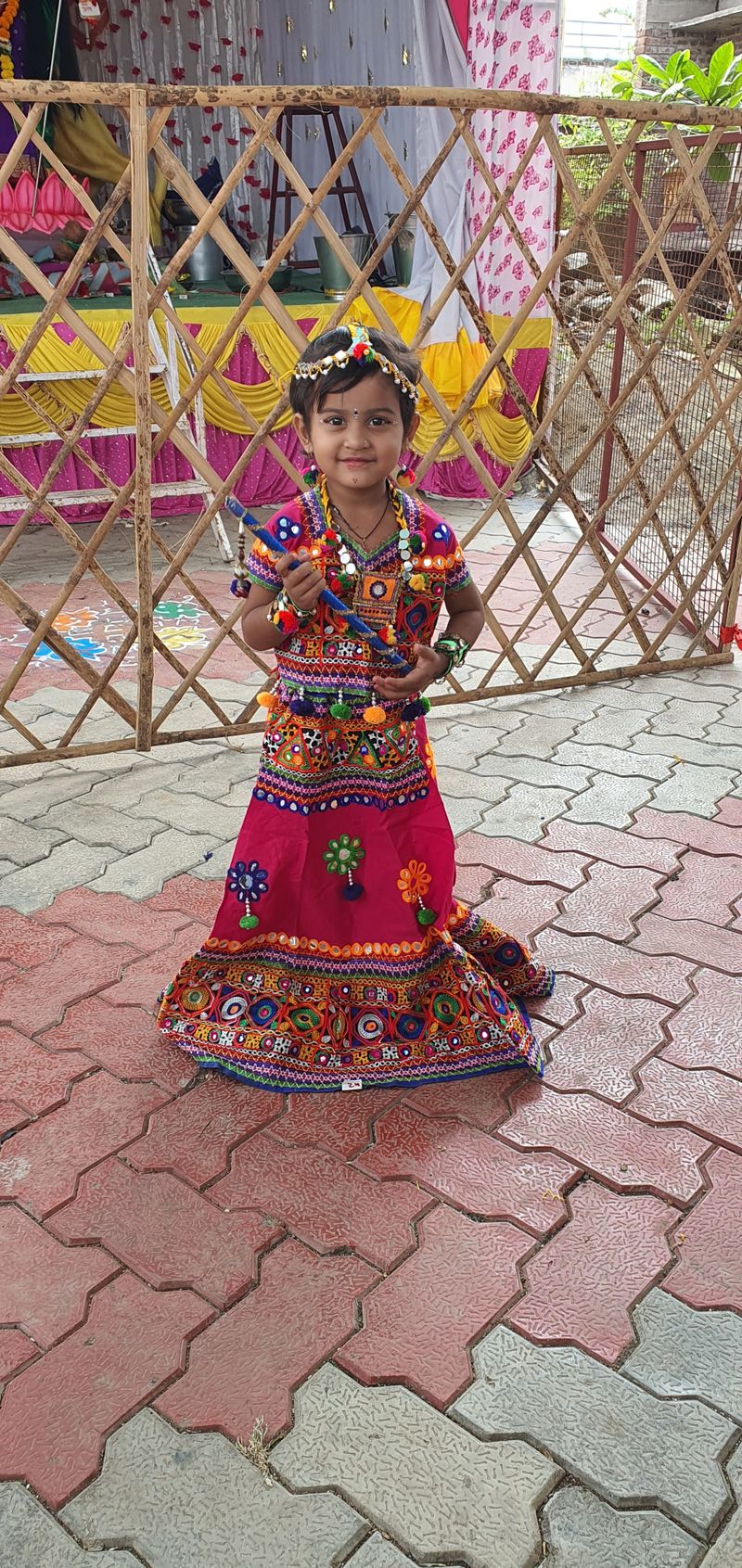
- Dress-up corner. Bangles, dupattas, and small mirror-worked pieces. A mirror and a good light source here will keep a group entertained between dances.
- Kanya Pujan involvement. If you're observing this tradition, give the children a real role — seating, washing feet, serving and receiving — rather than parking them at a side table.
- Storytelling slot. Twenty minutes of the Navdurga stories, told for a young audience, works as a genuine calm-down point in the middle of a loud evening.
- Quiet corner. Somewhere dim and comfortable with the LED diyas and a few books, for children and for older guests who need a break from the music.
Respectful Hosting: What to Know Before You Open the Door
A great Navratri party is culturally specific, and that's its appeal. A few practical points keep it warm for guests who are new to it.
Brief your guests, briefly. A one-line note with the invitation does most of the work: the colour of the evening, whether there's dancing, that footwear comes off near the altar, and whether the food is vegetarian. Guests who know what's happening relax and join in.
Keep it vegetarian and alcohol-free by default. Many households observe this during Navratri, and keeping the kitchen vegetarian is also the easiest way to keep your menu broadly safe. If you're serving alcohol at a non-religious gathering, keep it clearly separate from the worship area and the prasad table.
Avoid costume stereotyping. Encourage traditional dress — lehenga, chaniya choli, kurta, salwar — as an invitation, not a uniform. But do not treat the festival as a costume opportunity: no "tribal" or "exotic" framing, no makeshift costume that borrows from another tradition, and no pressure on guests who prefer to come in jeans.
Explain the rituals you're including. If you're doing Ghatasthapana, aarti or Kanya Pujan, a two-sentence explanation before you begin turns a moment where guests stand awkwardly to one they remember. Ask guests to keep phones down during aarti unless you've said otherwise.
Watch the photos. A dance floor is a great photo environment, but ask before posting close-ups of guests, and never post images of a home altar or puja without asking the household first.
Party Favours and Take-Home Gifts
Navratri favours tend to be small, colourful and genuinely useful — which makes them easy to get right.
- A single clay diya per guest, wrapped with a ribbon, is the classic and always lands well.
- A small box of sweets or a bag of makhana for guests who fasted.
- Bangles or a bindi card, presented at the door rather than as a prize.
- A mini rangoli stencil or a small packet of coloured sand.
- A seed packet — marigold or basil — as an end-of-festival parting gift.
Presentation does the heavy lifting here. A plain paper bag with a ribbon, a name tag and one bright element looks considered; the same items loose in a basket look like leftovers. Our party favors collection covers bag-and-filler combinations that work for adult and children's parties alike, and pairs well with a DIY assembly line an hour before guests arrive.
Planning Timeline and Budget
Four weeks out. Fix the date and which night you're hosting. Send invitations with the colour and dress note. Decide whether you're cooking or ordering, and book anyone you're hiring.
Three weeks out. Lock the menu into two tracks: vrat and non-vrat. Write your shopping list by dish. Order tableware, banners and favours so nothing is a last-minute scramble. Make your dandiya and diya counts.
Two weeks out. Test one dish from each track. Build the playlist and download it. Confirm guest numbers and any dietary requirements. Buy non-perishables and the altar items.
One week out. Clean and clear the dance space; tape cables and rugs. Print dish labels. Assemble favour bags. Charge every battery-operated light you own.
Two days out. Fresh flowers, fresh dairy, fruit. Soak the sabudana. Check that your plates actually survive a curry by testing one.
Party day. Rangoli and toran first, altar second, food table third, lights last. Serve the cold items out of coolers and top up throughout rather than putting everything out at once.
Budget shape. For a rough allocation, expect food and drink to be roughly half the total, decor and lighting about a quarter, and the remainder split between tableware, music and favours. Decor and tableware are where you can cut without anyone noticing — the food, the lighting and the playlist are what guests actually remember.
Navratri 2026 FAQ
When is Navratri in 2026? Sharad Navratri runs from Sunday, October 11 to Monday, October 19, 2026, followed by Vijayadashami (Dussehra) on Tuesday, October 20. Chaitra Navratri, the spring observance, ran from March 19 to March 27, 2026.
Which night should I host a party? Day 1 (October 11) and Day 9 (October 19) are the most attended, and Durga Ashtami on October 18 draws bigger crowds because of Kanya Pujan. If you want a calmer evening with more space, mid-week nights like Day 4 or Day 5 are noticeably easier to plan.
Do I have to fast to host a Navratri party? No. Fasting is a personal observance, not a host requirement. What matters is offering food that works for guests who are fasting, and labelling it clearly.
Is Navratri always vegetarian? For many households, yes, and vegetarian menus are the norm during the nine days. If you're hosting for a mixed group, an all-vegetarian menu is the simplest and most considerate default.
Can I host Navratri without any religious elements? You can host a garba night that focuses on dance, colour and food. Be straightforward about it rather than treating the festival as a theme — guests who celebrate Navratri should know what to expect, and the dance and food traditions themselves carry meaning.
What if guests don't know how to dance garba? Expect that most of your guest list doesn't. Teach one move before the music starts, keep an experienced dancer in the inner circle, and begin with slow tracks. Almost everyone is dancing within half an hour.
How much food should I plan per guest? For a two-hour evening with dancing, plan three to four small items per person rather than a full meal, plus a dessert and a drink. Dancers eat in passes, so it's better to serve 60% of the food and refresh than to put everything out at once.
How many diyas do I need? Roughly one per guest for favours, plus eight to twelve larger ones for the altar and entrance, plus six to ten for the food table. Fill the rest of the room with battery-operated lights.
What should I do if a guest accidentally eats non-vrat food? Nothing dramatic — it happens. That's why printed labels exist. Keep a couple of clearly marked vrat-only dishes at a separate table so there's always something safe to fall back on.
Is Dussehra a separate party? Dussehra on October 20 marks the end of the nine nights and is a distinct celebration, often marked with a community gathering and, in some traditions, the burning of effigies of Ravana. It's a natural closing event if you've been hosting through Navratri.
Host Nine Nights Your Guests Will Actually Remember
Navratri rewards preparation more than most parties, because the structure is already given to you: nine dates, nine colours, one dance form and one food tradition. Spend your effort on the three things that carry the evening — a cleared, safe dance floor; a two-track menu with clear labels; and lighting that makes an ordinary room feel like an occasion — and the rest follows naturally.
Start with the table and the dance floor, since those are the two elements every guest touches. Browse party tableware for colour-matched plates, cups and napkins; pick up snack cups for the grazing food that keeps dancers moving; and set aside a small budget for diyas and favours so everyone leaves with something. Nine nights is a lot of hosting — but it's also nine chances to get it right, and your first one will teach you everything you need for the rest.