


Tailgate Party Ideas: The Ultimate Game Day Guide

A tailgate is one of the few parties where the venue is a parking space, the kitchen is a folding table, and nobody minds. It works because the constraints are the point — you have limited room, limited power, and a hard start time dictated by kickoff, and those limits force a kind of efficiency that most home parties never achieve.
The season is nearly here. National Tailgating Day falls on the first Saturday of September — September 5 in 2026 — and college football's opening weekend lands in the same stretch, with the NFL following days later. That gives you a few weeks to sort out gear, work out a food plan that survives a cooler, and figure out how to feed a dozen people without a sink.
This is the practical version: what to bring, what to cook, what to skip, how to time it, and how not to be the group everyone in the lot resents.
The Gear That Actually Earns Its Space
Every tailgating guide lists forty items. In practice, about a dozen do ninety percent of the work, and the rest gets carried back to the car untouched.
- A portable grill. Propane over charcoal for most people — faster to light, faster to cool, and legal in more lots. Check your venue's rules before buying; some stadiums ban charcoal outright.
- Two coolers, not one. One for drinks, one for food. The drink cooler gets opened constantly; the food cooler needs to stay shut and cold. Mixing them is the single most common mistake in tailgating and the fastest route to warm chicken.
- A folding table with a fitted cover. Six feet is enough for eight to ten people. A fitted cover beats a loose tablecloth every time — parking lots are windy.
- Chairs, and one more than you think. Somebody always brings a friend.
- A canopy. Sun in September, rain in November. Weight the legs; a gust through an unsecured canopy is genuinely dangerous in a crowded lot.
- Trash bags — at least three. One for trash, one for recycling, one spare for wet or greasy items.
- Paper towels, wet wipes, and hand sanitizer. There is no sink. Plan accordingly.
- A power bank. Everyone's phone dies at tailgates, and you will need yours for tickets.
Beyond that: a bottle opener attached to something so it doesn't vanish, a cutting board, one good knife in a sheath, long tongs, aluminum foil, and a small first-aid kit. That is a complete kit, and it fits in a trunk.
For serving, sturdy matters more than pretty. Thin paper plates fold under a loaded burger and drop it on the asphalt. A heavier-weight plate from the disposable plates range holds up to chili and pulled pork, and stacking a set of plastic cups in the truck saves you from the annual glass-bottle-in-the-parking-lot conversation.
Claiming and Setting Up Your Spot
Arrive earlier than feels reasonable. Three to four hours before kickoff is standard at most college venues and not unusual at NFL stadiums. This is not about being first; it is about getting a corner or an end spot, which gives you a buffer on one side and roughly double the usable ground.
Once you have the space, set up in a fixed pattern so people learn where things are:
- Grill at the far edge, downwind if you can manage it, away from foot traffic and never under the canopy.
- Food table in the middle, with a clear path along one side so nobody has to squeeze past the grill.
- Drink cooler by the chairs, because that is where people are and it stops them wandering into the cooking area.
- Trash bags tied to the table legs at two corners. Visible bins get used; hidden bins do not.
- Games at the back or side, with a throwing lane that does not cross the food.
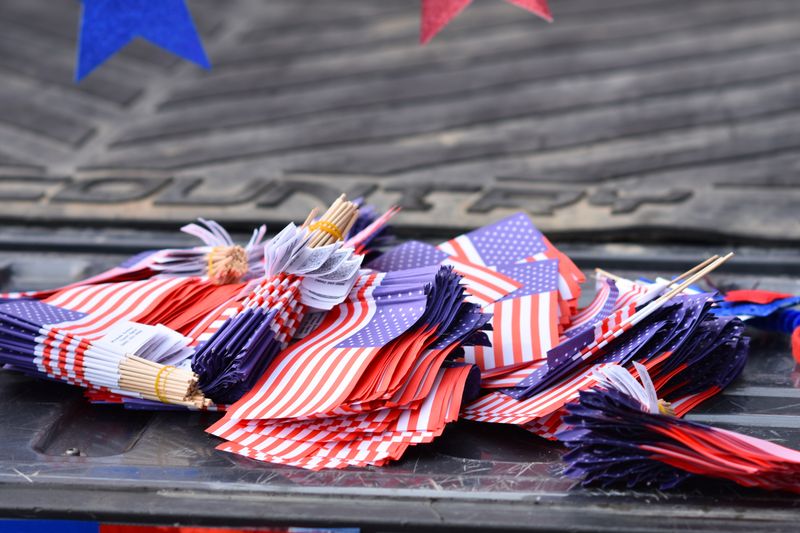
Mark your spot so people can find you. A flag on a pole, a distinctive canopy color, or a helium balloon cluster tied to the mirror all work. A lot of five thousand cars looks identical when you are three beers in and your friend is calling for directions.
Food: Everything That Can Be Made Ahead, Should Be
The best tailgate cooks do almost nothing at the lot. Grilling is theater and it should be the only live cooking you attempt. Chopping, mixing, marinating, and assembling all belong in your kitchen the night before, where you have a sink, a bin, and counter space.
The make-ahead core:
- Chili or pulled pork in a slow cooker. Cook it the day before, transfer it hot into a wide-mouth insulated container, and it will still be serving-temperature four hours later. If you have a power inverter or the lot has outlets, bring the slow cooker itself.
- Pasta salad, potato salad, or a slaw. All three improve overnight. All three are also the highest-risk items for temperature abuse, so they stay in the food cooler on ice until the moment they are served.
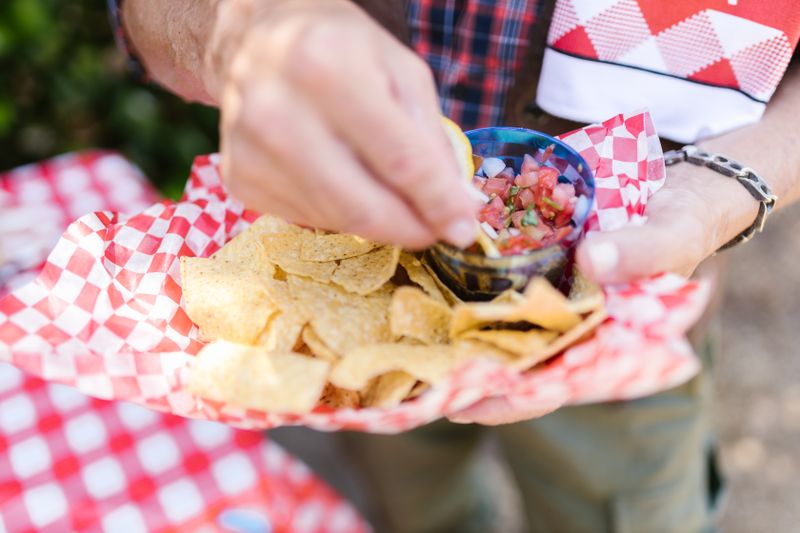
- Layered dips. Build them in a shallow container the night before, cover, and travel flat. Seven-layer dip and buffalo chicken dip are tailgate staples for good reason.
- Wings, cooked and reheated. Bake and sauce them at home, then finish on the grill for five minutes to crisp the skin. Far better than trying to cook wings from raw on a small grill.
- Pre-formed burger patties, separated by parchment squares. Forming patties in a parking lot with cold hands and no water is miserable.
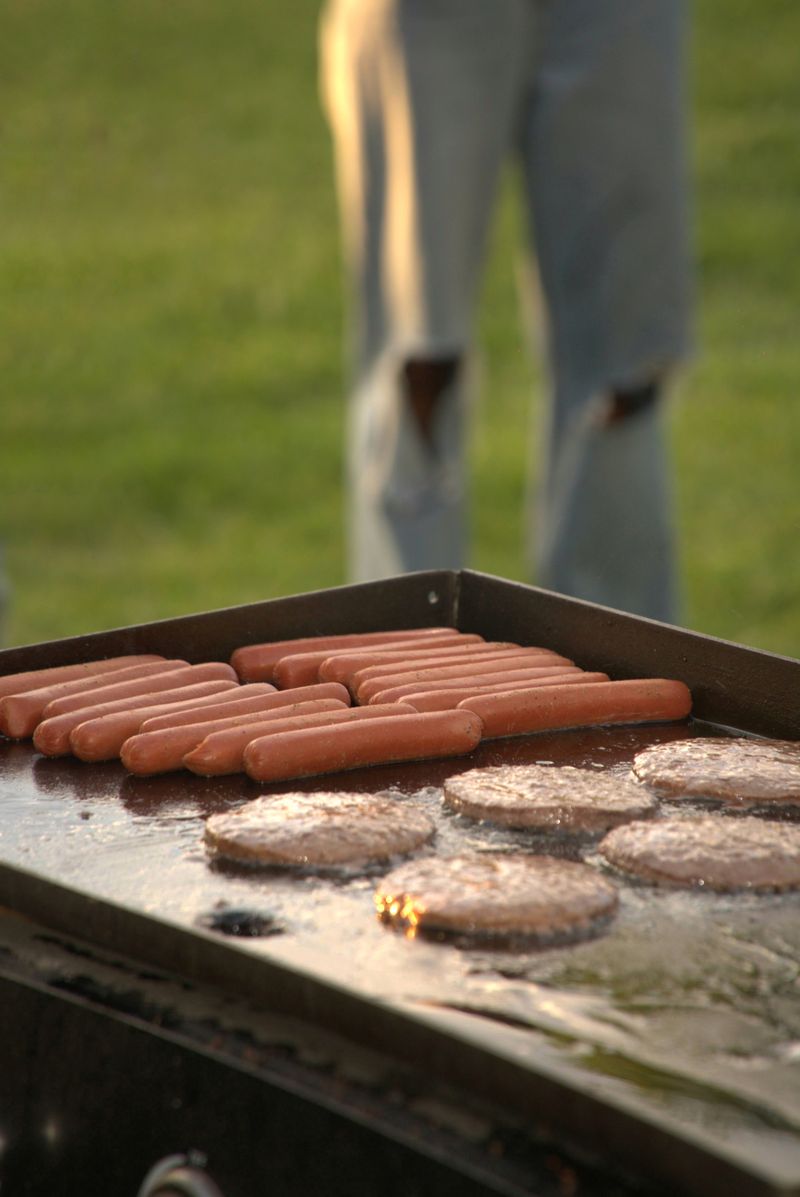
Keep the grill list short and fast: burgers, brats or hot dogs, and maybe skewers. Anything requiring more than fifteen minutes of attention will still be cooking at kickoff.
The Grill Plan
Light the grill about ninety minutes before kickoff, not earlier. Food that comes off too early sits and dries out, and you end up eating twice.
Cook in waves rather than all at once. Brats and hot dogs first — they hold well in a foil pan with a little beer or broth in the bottom, and they keep the early arrivals fed. Burgers second, timed so they come off ten minutes before you want to eat. Anything vegetarian goes on a clean section of grate or a piece of foil, and should be cooked before the meat rather than after, which is both the right thing to do and the thing most hosts forget.
A meat thermometer is not overkill. Parking-lot grilling happens in variable wind on unfamiliar equipment, and the visual cues you rely on at home do not translate. Ground beef and pork sausage need 71°C / 160°F; chicken needs 74°C / 165°F. It takes four seconds to check.
Bring more propane than one canister. Running out at 11am, three hours from home, with twenty raw burgers in a cooler, is a story you will be told about for years.
Drinks and the Cooler System
Pack the drink cooler in reverse order of demand: water and soft drinks on top where people reach first, beer below, and ice packed around rather than just on top. Freeze water bottles the night before and use them as ice blocks — they chill better than loose ice, they don't turn the bottom into a puddle, and they become drinkable as they melt.
Plan on more non-alcoholic drinks than you think. Between drivers, people who are pacing themselves, and September afternoons that are hotter than anyone expects, water outsells beer at most well-run tailgates. Two litres of water per person over a four-hour tailgate is a sensible baseline in warm weather.
On alcohol, three rules keep the day intact. Know your lot's policy — many venues ban glass, some ban alcohol entirely, and enforcement is real. Designate drivers before anyone opens anything, and hand that person their own cooler of good non-alcoholic options so it doesn't feel like a punishment. And stop serving at kickoff. The tailgate is the pre-game; the stadium has its own rules and its own prices, and arriving in the third quarter because the parking lot got away from you is a waste of a ticket.
Games That Work in a Parking Space
Space is tight and the ground is asphalt, which rules out most lawn games. What survives:
- Cornhole. The default for a reason — compact, playable by anyone, and boards double as extra surface when not in use.
- Ladder toss. Smaller footprint than cornhole and forgiving of uneven ground.
- Washer toss. The most space-efficient of the three and easy to make yourself.
- Football catch. Costs nothing, occupies teenagers indefinitely, and needs only a lane between cars.
- Score prediction pool. Everyone writes a final score on a card for a dollar; closest guess takes the pot. Runs itself and keeps people engaged through the game.
- Giant Jenga or Connect Four. Good for mixed-age groups and doesn't require throwing anything near a stranger's paintwork.
Keep at least one game that requires zero setup for the twenty minutes after arrival, while the canopy is still going up.
What It Costs
For a group of ten, tailgating a single game:
- Food — $80 to $140. Burgers, brats, a slow-cooker main, two sides, chips and dip.
- Drinks — $50 to $110. Beer, water, soft drinks, ice.
- Disposables — $20 to $35. Heavy plates, cups, napkins, cutlery, foil, trash bags.
- Propane — $15 to $25 per refill, amortized across several games.
- Parking — $20 to $60 depending on venue.
Per game: roughly $185 to $370, or $19 to $37 a head. Split it up front with a group payment app rather than chasing people afterward. The two biggest levers are buying drinks by the case rather than the six-pack, and rotating who hosts each week so gear and cost spread across the group.
The one-time gear investment — grill, coolers, table, canopy, chairs — runs $250 to $600 and pays for itself by the fourth or fifth game. Buy the cooler well and everything else cheaply; the cooler is the item where quality actually changes the outcome.
Game Day Timeline
The night before. Cook the slow-cooker main. Make the sides. Form the patties. Load everything non-perishable into the car — table, chairs, canopy, grill, games, disposables. Freeze the water bottles. Charge the power bank.
T-minus 5 hours. Pack the coolers. Food cooler: bottom layer of frozen bottles, meat in sealed containers on the ice, sides above. Drink cooler: same principle, drinks last in. Confirm the meeting point with your group.
T-minus 4 hours. Leave. Traffic near a stadium on game day is worse than any map app predicts, and the good spots go early.
T-minus 3 hours. Park, claim the space, put up the canopy, set the table, tie out the trash bags, deploy the games. Open the drink cooler.
T-minus 90 minutes. Light the grill. Set out the chips, dips, and cold sides.
T-minus 60 minutes. First wave off the grill. Serve.
T-minus 30 minutes. Stop cooking. Pack leftovers straight into the cooler. Start breaking down.
T-minus 15 minutes. Grill off and cooling, everything in the car, bags in the bin, one last sweep of the ground. Walk in.
Parking Lot Etiquette
You are hosting a party three metres from someone else's party, and the difference between a good lot and a bad one is entirely down to behavior.
Stay inside your space. Canopy legs, chairs, and cornhole lanes that creep into a neighbor's spot are the most common cause of friction. Keep music at a level where your own group can talk over it — you are not the lot's DJ. Never grill between two vehicles. Watch where smoke is blowing and shift the grill if it is going into someone's setup.
Take everything with you. Leaving bagged trash beside your car is not the same as disposing of it, and lots that get trashed lose tailgating privileges, which affects everyone. Do a final walk of your footprint looking for bottle caps, foil, and cup lids — the small things that blow away and end up in a storm drain.
Offer a beer or a plate to the group next to you. It costs almost nothing and it is how you end up with a standing tailgate group by mid-season.
Late-Season and Cold-Weather Tailgating
By November the whole calculation changes. Layers matter more than gear: thermal base layer, insulated boots, and a hat, because you lose heat fastest from your head and feet standing on cold asphalt.
Swap the menu toward things that hold heat — chili, soup, stew, hot chocolate, mulled cider. Insulated containers earn their keep here. Bring a windbreak; canopy sidewalls or even a tarp strung between two vehicles makes a large difference to perceived temperature.
Alcohol makes you feel warmer while actually accelerating heat loss, which is worth knowing before a 1pm kickoff in freezing conditions. Hot non-alcoholic drinks do more for comfort and more for the afternoon.
Food Safety Without Being Precious About It
Parking lots in early September can sit above 30°C. Perishable food should not be out of refrigeration for more than two hours, and above 32°C that window drops to one hour. This is the one area where casualness genuinely causes harm.
Keep raw meat in sealed containers at the bottom of the cooler so nothing drips onto anything else. Use separate tongs and a separate plate for raw and cooked — a marked platter and a marked pair of tongs solves it entirely. Put mayonnaise-based sides out in small batches and keep the rest on ice rather than setting out the whole bowl. And when you pack up, if the cooler ice has fully melted and the leftovers have been sitting warm for hours, throw them out. The cost of a wasted pasta salad is much lower than the alternative.
Frequently Asked Questions
How early should I arrive?
Three to four hours before kickoff for a standard game; five or more for a rivalry game or a season opener. Check whether your venue's lots have a fixed opening time — many do, and arriving before it just means queueing.
Charcoal or propane?
Propane, unless you strongly prefer charcoal flavor and your lot allows it. Propane lights faster, cools faster, and produces no hot ashes to dispose of, which is the main practical headache with charcoal at a stadium.
How much food per person?
Plan on one and a half grilled items per adult plus two sides. People eat more at tailgates than at dinner parties because they are outdoors and grazing for hours.
Can I tailgate without a truck?
Easily. A sedan trunk holds a folding table, two chairs, a cooler, and a small grill. The truck bed is convenient, not required.
What about tailgating for a game we're watching at home?
The whole format works in a driveway or backyard, and you gain a bathroom and a fridge. Same timeline, same menu, same games — start three hours before kickoff and move inside for the broadcast.
Do I need a permit?
Not usually for standard lot tailgating, but rules vary sharply by venue on grills, alcohol, generators, amplified music, and canopy size. Read your stadium's tailgating policy page once, at the start of the season.
Get the Season Started Right
A good tailgate is a logistics exercise disguised as a party. Cook ahead, run two coolers, arrive early, keep the grill list short, and clean up properly — do those five things and the rest takes care of itself.
Stock the table before the opener rather than the morning of. Team-color plates, napkins, and cups from our sports party supplies collection sort the presentation out in one order, and the BBQ party supplies range covers the heavy-duty serveware that actually survives a loaded plate of pulled pork. See you in the lot.