


Kenya Mashujaa Day 2026 Party Ideas: Color, Food and Safari Guide

Every October 20, Kenya stops for a day and throws the country's biggest block party. It's called Mashujaa Day — Heroes' Day — and in 2026 it falls on Tuesday, October 20. Stadiums fill up before sunrise, school choirs rehearse for weeks, and families pile into cars heading upcountry for a long weekend of nyama choma, loud music and more than a little dancing.
If you've been looking for a party theme that is genuinely different from the usual pink-and-gold birthday setup, Mashujaa Day is a gift. Kenya gives you an unmistakable color story (the flag's black, red and green), a food culture built for feeding a crowd, a craft tradition that turns into party favors almost by itself, and a soundtrack that gets people out of their chairs. It also gives you a real reason to gather: honoring the people who helped build a nation.
This guide walks through the whole thing — decor, table, menu, drinks, games, music, budget tiers, a hosting timeline you can actually follow, and a few regional variations you can borrow. Whether you're Kenyan, part of the diaspora, a teacher planning a school celebration, or just a host looking for a bright, joyful theme, here's how to build it.
What Mashujaa Day Actually Is
Getting the background right makes the party better, because it tells you what you're celebrating. Mashujaa is Swahili for "heroes." The holiday was observed for decades as Kenyatta Day, and it was renamed Mashujaa Day under the 2010 Constitution so that instead of honoring one figure, the country honors all the people who contributed to Kenya's freedom and nation-building.
The date itself is deliberately loaded. On October 20, 1952, the colonial administration declared a state of emergency and arrested leading independence figures in what became known as the Kapenguria trial. That moment became the starting point of a long national struggle, and October 20 became the day Kenya marks it.
Today the celebration rotates around the country to a different host county each year. The format is consistent: a national parade, military and police bands, cultural performances from every region, traditional dancers in full regalia, a presidential address, and an awards ceremony recognizing Kenyans who have contributed to the country. In villages and neighborhoods, the formal part ends and the real party begins: food, music, football, and family.
A quick framing note if you're hosting outside Kenya: Mashujaa Day is a national holiday about pride, service and culture. Keep your party focused on the food, the music, the crafts and the shared meal. That's what Kenyans themselves celebrate, and it travels beautifully.
Why This Theme Works So Well for Hosting
Three practical reasons make Mashujaa Day an unusually host-friendly theme.
First, the colors are already a complete design system. Kenya's flag is black on top, red in the middle, green on the bottom, separated by thin white bands, with a red, white and black Maasai shield and two crossed spears in the center. Black stands for the people, red for the blood shed for freedom, green for the land, white for peace, and the shield and spears for the defense of everything above. You never have to invent a palette — you just deploy it. Black, red and green with white as the neutral is high-contrast, photographs well, and works equally for a kids' table and a formal dinner.
Second, Kenyan food is naturally scalable. Nyama choma (grilled meat), ugali (maize meal), sukuma wiki (sautéed collards) and kachumbari (fresh tomato-onion salad) are all dishes designed to feed many people from shared platters. Nothing on the core menu needs plating skills or last-minute precision.
Third, the craft tradition gives you built-in activities and favors. Beadwork, batik, soapstone carving and woven kiondo baskets aren't decorations you buy — they're things a table full of guests can actually make.
Decor: Flag Colors, Kitenge and Safari Accents
Start with the palette and work outward. A practical split for a 30-guest party: roughly half the table in neutral (kraft paper, wood, white linen), a quarter in red, and a quarter shared between black and green. If you make all three flag colors equal, the room turns into a flag. Ratio is what makes it a party instead of a parade.
Here's a layering plan that reads as intentional rather than themed:
- Base layer: a plain tablecloth plus a runner. A red or forest-green runner over a kraft or white base gets you 80% of the look in one move.
- Pattern layer: kitenge or kanga fabric — the East African wax-print cloth. Kanga is the printed cotton with a Swahili proverb worked into the border, which makes it a wonderful conversation piece. Drape it as a runner, tie it around chair backs, or use it as a photo backdrop.
- Texture layer: woven baskets, sisal placemats, carved wooden boards, and a few pieces of soapstone. These add warmth without adding color noise.
- Safari accents: acacia silhouettes, animal-figure cutouts, and a few rattan or dried-grass elements. Kenya is the home of the safari, so this is authentic theme territory, not a costume.
- Light layer: string lights in warm white. Skip colored bulbs — they fight the flag colors.

The shuka deserves special mention. It's the red plaid cloth worn by Maasai herders, and it appears in several colorways. Draped across a side table or hung flat on a wall, a shuka immediately reads as East Africa in a way that no printed banner can. If you use one, treat it as a textile you're borrowing, not a costume — hang it, don't wear it as a joke.
For the centerpiece, keep it low so people can see across the table. A wooden board with three small bowls works better than anything tall: one bowl of black beans or dark stone, one of red lentils or chiles, one of green herbs. It's the flag, it's food, and it costs almost nothing.
Setting the Table with Tableware That Does the Heavy Lifting
Disposable tableware is the quiet hero of a big cultural feast, because the host should be eating nyama choma with everyone else, not standing at a sink. Build the table in three trays instead of trying to make every place setting match:
- Main plates: sturdy paper plates with a wide rim — they hold rice, stew and grilled meat without collapsing. A wood-grain or kraft finish suits the palette better than glossy white.
- Small plates and bowls: for chutneys, kachumbari and dessert. Paper bowls handle sauces better than a flat plate.
- Cups: two per person minimum, because chai and juice are both happening. Tall paper cups for the cold drinks, short ones for tea.
Napkins are where you get to be clever. A plain white or dark napkin, tied with a strip of kitenge fabric, becomes a favor and a place marker at the same time. If you want the table to look genuinely styled rather than assembled, that one detail does it.
You can build the whole table from our party tableware collection, which covers plates, bowls, cups and napkins in finishes that work with a black-red-green palette. For the serving side, plain wooden boards, woven baskets lined with cloth, and enamel trays all read as East African rather than generic party supply.
The Menu: Nyama Choma, Ugali and a Full Kenyan Feast
Kenyan food is built for sharing, which is exactly why it works at a party. Here's a menu that covers the essentials without requiring you to cook twelve separate things.
The centerpiece — nyama choma. Literally "grilled meat," and the single most iconic Kenyan party food. Goat is the classic, beef and chicken are the common alternatives. The traditional preparation is minimal: salt, maybe a little lemon, and time over charcoal. Serve it chopped into bite-sized pieces on a big wooden board with kachumbari alongside. If you don't have a charcoal grill, a gas grill with a handful of wood chips gets you close.
The staple — ugali. White maize meal cooked with water until it forms a firm, sliceable block. It's the thing you use to scoop everything else. Making it well is genuinely a skill: you add the flour to boiling water gradually, stir hard with a wooden spoon or a proper ugali stick, and keep going until it pulls cleanly away from the sides of the pot. It should be firm, not sticky. A shortcut for big parties: make it in two or three batches rather than one enormous pot, because a giant pot is hard to stir and lumps form fast.
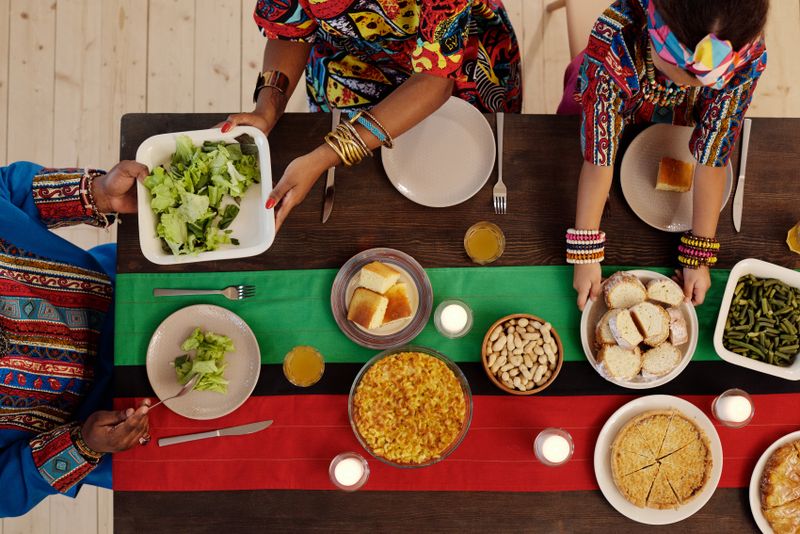
The supporting cast:
- Sukuma wiki — collard greens sliced thin and sautéed with onion, tomato and a little oil. Cheap, fast, and the dish people go back for.
- Kachumbari — finely diced tomato, red onion, cilantro or parsley, lime or lemon juice, salt. Chill it. It cuts through the richness of the grilled meat.
- Chapati — soft, layered flatbread. Make them ahead and stack them under a towel; they reheat beautifully.
- Pilau — spiced rice with cumin, cardamom, cinnamon and cloves, often cooked with meat. This is your coastal and Swahili-coast contribution, and it's the dish that makes the table feel abundant.
- Samosas — spiced beef or vegetable filling in a crisp pastry triangle. Buy them frozen by the tray if you're feeding a crowd; nobody at the party is grading your folding technique.
- Githeri or mukimo — a maize and bean stew, or the mashed version with potatoes, maize and greens. Hearty and inexpensive, perfect for a large guest list.
- Mandazi — lightly sweet fried dough, somewhere between a doughnut and a beignet. Serve with tea or as dessert with a drizzle of chocolate.
Dessert and fruit. A platter of mango, papaya, pineapple and watermelon is the correct Kenyan dessert. Add mandazi and, if you want something cold, a simple fruit sorbet. Skip anything heavily frosted — nobody wants buttercream after nyama choma.
Drinks: Kenyan Chai, Dawa and Tropical Juice
Drinks are where a good Mashujaa Day party separates itself from a generic cookout.
Kenyan chai is the national drink and it is not the same as a tea bag in hot water. You boil water, add loose black tea and milk together, then cardamom, ginger, sometimes cinnamon and cloves, and let it simmer until it's the color of terracotta. Sweeten generously. Serve it in batches from a thermos or a slow cooker on low — a big pot of chai on the table makes a party feel immediately hospitable.
Dawa is the Kenyan cocktail, invented in Nairobi and named with the Swahili word for "medicine." The classic build is vodka, honey, lime and crushed ice, stirred with a wooden honey dipper so a little honey dissolves into each glass. It's a naturally refreshing drink, and it's easy to batch in a pitcher for adults. Make a fully non-alcoholic version by dropping the vodka and adding soda water and a little extra lime — kids and non-drinkers should get the same glassware and the same garnish, not a sad aside cup.
Non-alcoholic lineup:
- Passion fruit juice — widely available as concentrate and intensely fragrant. One part concentrate to three parts water, over ice.
- Sugarcane or fresh mango juice — naturally sweet, no added sugar needed.
- Hibiscus or tamarind cooler — tart, deep red, and it stacks neatly into the flag palette.
- Water station — a big dispenser with lemon slices. With heavily spiced food and cardamom tea, people drink more water than you expect.
Serve everything in clear glasses where you can, so the drink colors show. A tray of deep red hibiscus cooler, green mint-lime soda and dark cola over ice is the flag, in drinks, without a single flag decoration on the table.
A Kids' Table That Actually Gets Eaten
The mistake hosts make with a themed kids' menu is serving the adult dishes unseasoned and hoping for the best. Instead, build a parallel plate that's clearly its own thing:
- Mini nyama choma skewers — small grilled chicken or beef cubes on a stick. Kids eat anything on a stick.
- Plain chapati wedges — soft, familiar, and a good vehicle for dipping.
- Ugali rounds — cut into circles with a cookie cutter and let kids treat them like bread.
- Kachumbari, deconstructed — cucumber and tomato slices on the side, dressing off. Kids assemble their own.
- Mandazi — the guaranteed winner. Make extra.
- Fruit skewers — mango, watermelon and pineapple on a stick, in a cup so it doesn't roll off the plate.
Use the flag colors in the kids' table itself: a red tablecloth, black cups, green napkins. Add a simple coloring sheet with a Kenyan flag outline and a couple of safari animal outlines, plus a cup of crayons per three children. That single station will absorb twenty minutes of restless energy exactly when you need it.
Games and Activities: Adumu Jumps, Safari Bingo and Bead Stations
The best party activities for this theme are the ones rooted in actual Kenyan traditions, adapted so nobody feels like they're performing a stereotype. Stick to games that invite participation, and always explain where they come from.

1. The jumping contest (Adumu-inspired). In Maasai tradition, warriors perform adumu, a vertical jump from a standing position without bending the knees, traditionally accompanied by a rising vocal hum. Set up a jump challenge: feet together, no running start, hands at your sides, and mark the highest point with a piece of removable tape on a wall. Do rounds of elimination and award a beaded bracelet to the winner. Keep the commentary respectful — describe it as a Maasai tradition you're borrowing for the afternoon, not as a novelty act.
2. Safari bingo. Make 5x5 cards with animal names — lion, elephant, rhino, giraffe, zebra, cheetah, hippo, wildebeest, flamingo, buffalo. Two ways to play: call out facts as clues ("this animal migrates in the Great Migration"), or use printed photos as call cards. It works for ages five to eighty and needs no equipment beyond the cards.
3. Bead bracelet station. Beadwork is a genuine Kenyan craft tradition, from Maasai flat collars to finely strung bracelets. Set out bowls of beads sorted by color — black, red, green and white, matching the flag — plus elastic cord and a few scissors. Give each guest a small card with two or three Maasai-inspired patterns they can copy. Everyone leaves with a favor they made. This station runs itself for an hour.
4. Kanga proverb relay. Write four or five Swahili proverbs on slips of paper with the English translation. Teams draw one and have to act it out silently while their team guesses. It's charades with a cultural payoff, and it teaches people something about the coast while they laugh.
5. Relay races, Kipchoge style. Kenya's distance-running heritage is a legitimate party engine. Set up a straight-line relay with a baton, or a "predict your time" race where each guest guesses their own finish time and the closest guess wins. For a version that works in a small space, do a shuttle run with stacked cups that have to be moved one at a time. Award the winner a small trophy or a bag of Kenyan tea.
6. Bao or mancala. Bao is the Swahili name for the family of mancala board games played widely along the East African coast, and it's genuinely strategic. Print simple boards on card stock, use dried beans as pieces, and include a one-page rules sheet. Put it on a side table for the guests who don't want to dance. It's the quiet corner activity every party needs.
7. Kenyan trivia, three rounds. Round one: flag colors and what each stands for. Round two: the capital, the currency, the official languages. Round three: music and food. Keep the questions factual and generous, and hand out small prizes. This works especially well for workplace celebrations, where people genuinely want to learn something.
Music and Dance
The soundtrack is where the party stops feeling like a lecture and starts feeling like a party. Build a playlist across regions rather than looping one genre, and let it move:
- Benga — the classic Kenyan guitar sound, fast and bright. This is your opener while people arrive.
- Taarab — the coastal Swahili style with strings, oud and a slower, swooning feel. Good for the dinner hour.
- Ohangla and Isukuti — Luo rhythms driven by drums, heavy on percussion. This is your dance-floor ignition.
- Mugithi — the Kikuyu guitar-and-vocal sound, often performed live at parties.
- Genge and Kenyan hip hop — the modern club sound. Put this at the end of the night.
- Contemporary Kenyan pop — the artists your younger guests already have on their phones.
Sequence it deliberately: Benga and Taarab for the first hour while people eat, percussion-driven tracks when the food is done, then modern tracks after dark. If you have space, clear an area and let the kids go first — adults who say they don't dance will join in once the under-tens are already out there.
Crafts and Favors: Beads, Soapstone and Kiondo
Favors for this theme can be things people make (bead bracelets, batik-dyed bandanas, stamped kitenge bookmarks) or things you source (small soapstone animals, woven keyrings, tea sachets, beaded keychains). Three rules that keep favors from becoming clutter:
- One useful item beats three trinkets. A honey dipper for the Dawa recipe, a tea strainer, or a small woven pouch people will actually keep.
- Pair the favor with a card. A five-line card explaining the Dawa recipe or the meaning of the flag's shield turns a trinket into a keepsake.
- Bag it in something on-theme. Kraft paper bags with a strip of kitenge fabric and a Swahili word written on the front — Asante (thank you), Karibu (welcome), Harambee (pulling together) — cost very little and look deliberate.
Our party favors collection has the bag, tag and filler components; the cultural content is the part you write yourself, and it's the part guests remember. Add a bead station and you can send everyone home with both a handmade bracelet and a bagged treat.
If you're hosting a larger event — a school, a church, a workplace floor — a single shared craft table plus simple bagged favors scales better than individual gift bags. Divide the craft table into color-coded bead zones and put one adult or older teen at each station.
Budget Tiers
Culturally themed parties are usually cheaper than their mainstream equivalents, because the decorations are textiles and food rather than custom-printed props. Three realistic tiers for 25 to 30 guests:
- Backyard and DIY — roughly $250 to $500. Charcoal grill running, ugali and sukuma wiki making up the volume of the plate, chicken and one tray of goat as the centerpiece, fruit platter for dessert, chai in a slow cooker, DIY bead station, printed paper tableware, one borrowed kitenge for the runner, phone playlist over a Bluetooth speaker.
- Community hall or clubhouse — roughly $700 to $1,500. Full nyama choma station with goat and beef, pilau and samosa from a local caterer or shop, layered decor with a fabric backdrop and string lights, a proper playlist with a rented speaker, prizes for games, and a favor bag per guest.
- Venue and catered — roughly $2,500 and up. Everything above plus a hired grill master, a coastal Swahili course alongside the nyama choma station, a live band or DJ, a photo area with a fabric backdrop, and a printed menu card on each table explaining each dish. At this level, spend the extra money on the food and the music, not on printed signage — that's what guests actually experience.
The single best place to save money is the menu, because Kenyan food is inherently inexpensive. The single best place to spend it is enough meat for seconds.
A Hosting Timeline That Works
Four weeks is plenty of time for this theme if you sequence it properly.
Four weeks out. Set the guest count and decide the tier. Choose the date — note that in 2026 the holiday itself is Tuesday, October 20, and many Kenyan families celebrate on the nearest weekend, so either Saturday October 17 or Saturday October 24 is a completely reasonable party date. Send invitations with the date, time, the "come hungry" note, and one line explaining what Mashujaa Day is and how to say it (ma-SHOO-jah).
Three weeks out. Source your textiles — kitenge, kanga, a shuka — from an African fabric shop, online seller or a friend's closet. Order tableware, favor bags and beads. Build the playlist. Decide the menu and write the shopping list.
Two weeks out. Confirm the grill and charcoal. Order meat and either a whole goat or a mix of goat and beef from a butcher who can cut it for grilling. Buy non-perishable pantry items: maize meal, tea, cardamom, spices for pilau, frozen samosas. Test one batch of ugali — if you have never made it, this is the week to find out what your pot does.
One week out. Print safari bingo cards, trivia sheets and bao boards. Write the favor cards. Confirm help — someone on the grill, someone on drinks, someone on the craft table. Make the kachumbari dressing and the Dawa syrup ahead; both keep.
Two days before. Shop for produce, fruit and drinks. Wash and chop the collards. Make chapati dough or buy them. Charge the speaker. Clean the cooler.
The day before. Make the chapati and stack them. Make the pilau base. Cut fruit and refrigerate covered. Set the table completely empty so you can see the look and fix anything off. Freeze ice — more than you think you need.
The day of. Fire the grill two hours before guests arrive; nyama choma needs time and a low flame. Make ugali ninety minutes ahead and keep it wrapped in a warm towel. Put the chai on. Set out the bead station last, so it's the first thing people touch after they eat. Then put down your own plate and sit with your guests — that is the whole point of the holiday.
Regional Variations You Can Borrow
Kenya is not one food culture, and the variation is a feature you can use. Pick one regional angle to make your party more specific:
- Coastal Swahili. Pilau, biryani, coconut-heavy curries, samosas, mahamri and Taarab music. If you want a single-dish party, this is the direction to take.
- Central highlands (Kikuyu). Nyama choma, mukimo (mashed potatoes, maize and greens), githeri, chapati and Mugithi music. This is the classic "come over on Saturday" spread.
- Western and Nyanza (Luo). Fish from Lake Victoria, ugali, and Ohangla rhythms. Grilled tilapia instead of goat makes this a genuinely different menu.
- Rift Valley (Kalenjin). Mursik, ugali, hearty greens, and an athletic theme — great excuse to run the relay games.
- Maasai. Grilled meat, milk-and-blood traditions adapted for modern guests, shuka textiles, beadwork, and adumu jumping as the game.
If you're hosting for the diaspora, blending two or three of these is normal and usually reflects how the family actually eats on the day. If you're hosting for neighbors who have never had Kenyan food, the Central highlands spread is the friendliest entry point, with the coastal pilau as the dish that surprises people most pleasantly.
FAQ: Hosting a Mashujaa Day Party
When is Mashujaa Day in 2026?
Tuesday, October 20, 2026. It's a public holiday in Kenya every October 20, and because it lands on a Tuesday, many families celebrate on the weekend of October 17 or October 24 instead.
What does "Mashujaa" mean?
It's Swahili for "heroes." Mashujaa Day honors everyone who contributed to Kenya's independence and nation-building, not a single individual — which is why it's often described as a national day of service and reflection as well as celebration.
What colors should I use?
Black, red and green with white as your neutral, taken from the Kenyan flag. Black represents the people, red the struggle for freedom, green the land, white peace, and the shield and crossed spears the defense of the nation. Use them in roughly 50/25/25 proportion so the room doesn't turn into a literal flag.
Is it appropriate to host this party if I'm not Kenyan?
Yes, provided you do it as appreciation rather than imitation. Learn what the date means, credit the dishes and crafts by name, avoid dressing guests in "safari costumes," and don't turn sacred or ceremonial elements into party gags. Explain the holiday to your guests — that's what makes it a celebration rather than a theme.
What food is absolutely essential?
If you only make three things: nyama choma, ugali and kachumbari. Those three together are the recognizable core of a Kenyan celebration. Add chapati and chai and you're at a complete table.
How do I make ugali properly?
Bring water to a rolling boil, start with a little maize flour stirred in to make a thin paste, then add the rest gradually while stirring hard and continuously with a wooden spoon. Keep cooking and folding until the mixture is smooth, firm and pulls away from the sides of the pot. Serve it warm, cut into wedges or scoops. If it's sticky rather than firm, it needs more time and more flour.
Can I do this as a school or workplace celebration?
Absolutely, and it's a strong format for it. Use the trivia rounds, safari bingo, a bead table and a simplified menu — samosas, chapati, mandazi, fruit and chai. Talk about the flag's meaning and the idea of "mashujaa," then let people eat. Half an hour for the cultural piece, one hour for food, and everyone leaves better informed than they arrived.
What if I can't find kitenge or kanga locally?
Look online for "African wax print fabric" or "kanga cloth" — it ships easily and is inexpensive by the yard. If timing is tight, a bold geometric print plus a red plaid textile gets you close enough, and your tableware and food will carry the theme.
How much food per person should I plan?
For a mixed menu, roughly 8 ounces of grilled meat per adult, one generous scoop of ugali, and about one cup each of the vegetable sides. Then over-provide chapati — it disappears faster than any estimate predicts.
Closing: A Party With a Reason
What makes Mashujaa Day work as a party theme is that it doesn't need to be explained away. The colors mean something, the food comes from a real culinary tradition, the crafts are made by real artisans, and the date commemorates something a nation is proud of. You're not decorating a room with a motif — you're cooking a meal that a lot of people care about, on a day they care about.
So keep it simple and generous. A charcoal grill, a pot of ugali, a board of nyama choma, a bowl of kachumbari, cold drinks in three colors, chai on the table, a playlist that moves from Benga to modern pop, and one row of guests trying to out-jump each other on the lawn. That's the whole formula, and it has been working in Kenya every October for decades.
Start with the table: our party tableware for the plates, bowls and cups, and the party favors collection for the bead-station bags and thank-you gifts. Add a red or green runner, a borrowed kitenge, and a plate of mandazi, and you're ready for October 20 — Karibu, and Harambee.